Website Accessibility
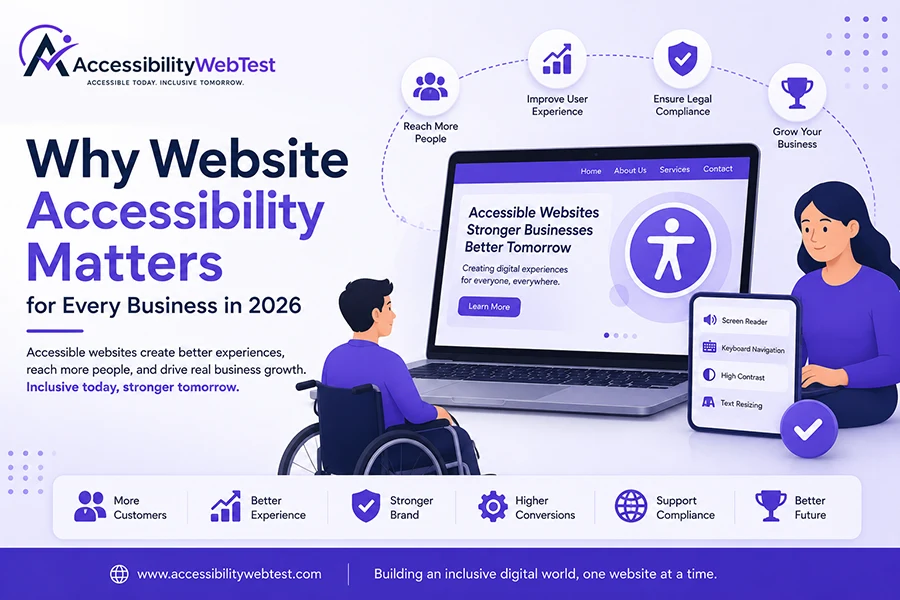
Why Website Accessibility Matters for Every Business in 2026
Introduction
Imagine investing thousands of dollars in designing a beautiful website, running marketing campaigns, and attracting visitors—only to discover that many potential customers cannot use your website because it isn't accessible.
Unfortunately, this happens more often than many businesses realize.
A website is often the first interaction a customer has with your brand. If visitors cannot navigate your website, read its content, complete a purchase, or submit an inquiry because of accessibility barriers, they are likely to leave and choose a competitor.
Website accessibility is no longer just about compliance or supporting users with disabilities. It has become a key part of delivering a great user experience, building customer trust, improving search engine visibility, and reaching a wider audience.
Whether you're a startup, an enterprise, an educational institution, or a government organization, accessibility should be a core part of your digital strategy.
In this guide, we'll explore why website accessibility matters, how it benefits your business, and why investing in accessibility is a smart long-term decision.
Table of Contents
What Is Website Accessibility?
Why Accessibility Matters Today
Who Benefits from Accessible Websites?
Business Benefits of Website Accessibility
Accessibility and User Experience
Accessibility and SEO
Accessibility and Brand Reputation
Accessibility and Legal Compliance
Common Misconceptions About Accessibility
Getting Started
Frequently Asked Questions
Final Thoughts
What Is Website Accessibility?
Website accessibility is the practice of designing, developing, and maintaining websites so that people of all abilities can use them effectively.
This includes users who:
Are blind or have low vision.
Are deaf or hard of hearing.
Have limited mobility.
Have cognitive or learning disabilities.
Use assistive technologies such as screen readers or voice control software.
An accessible website also benefits users without disabilities by providing clearer navigation, better readability, and more intuitive interactions.
Accessibility is about creating digital experiences that work for everyone.
Why Accessibility Matters Today
The digital world has become essential to everyday life. People rely on websites to shop, access healthcare, manage finances, apply for jobs, learn online, and communicate with businesses.
If your website isn't accessible, you're unintentionally excluding potential customers from using your products or services.
Modern users also have higher expectations. They expect websites to be easy to navigate, fast to load, mobile-friendly, and accessible regardless of the device or technology they use.
Accessibility helps meet these expectations while creating a more inclusive digital experience.
Who Benefits from Accessible Websites?
Accessibility benefits a wide range of users, including:
People with permanent disabilities.
Older adults experiencing age-related changes in vision or mobility.
Users with temporary injuries, such as a broken arm.
People using mobile devices in bright sunlight.
Users in noisy environments who rely on captions.
Individuals with slow internet connections.
People using keyboards instead of a mouse.
By designing for diverse needs, businesses create websites that are easier for everyone to use.
Business Benefits of Website Accessibility
Accessibility is not just a social responsibility—it also delivers measurable business value.
Reach a Larger Audience
Millions of people worldwide live with disabilities. An accessible website enables your business to serve a broader customer base and removes unnecessary barriers to engagement.
Improve User Experience
Accessibility encourages clear navigation, readable content, intuitive forms, and predictable interactions. These improvements enhance the experience for every visitor, not just those with disabilities.
Strengthen Customer Trust
When users can easily access your content and complete important tasks, they are more likely to view your business as professional, reliable, and customer-focused.
Increase Conversion Rates
Visitors are more likely to complete purchases, submit forms, or contact your business when they encounter fewer usability barriers.
Reducing friction throughout the customer journey can directly improve conversion rates.
Accessibility and SEO
Many accessibility best practices align closely with search engine optimization.
For example:
Semantic HTML helps search engines understand your content.
Descriptive headings improve page structure.
Alternative text provides context for images.
Clear navigation supports better crawling and indexing.
While accessibility alone won't guarantee higher rankings, it contributes to a stronger technical foundation that benefits both users and search engines.
Accessibility and Brand Reputation
Consumers increasingly expect businesses to demonstrate inclusivity and social responsibility.
An accessible website communicates that your organization values every customer and is committed to creating equal access to digital services.
This commitment can strengthen customer loyalty and differentiate your brand in competitive markets.
Accessibility and Legal Compliance
Many countries have laws and regulations that require digital accessibility.
Depending on your industry and target markets, accessibility may help support compliance with requirements related to:
ADA (United States)
Section 508 (United States)
European Accessibility Act
Equality Act (United Kingdom)
EN 301 549
Other regional accessibility regulations
Building accessibility into your website early is generally more efficient than retrofitting it later.
Common Misconceptions About Accessibility
"Accessibility is only for people with disabilities."
Accessibility improves usability for everyone.
"Accessibility is too expensive."
Addressing accessibility during design and development is typically more cost-effective than making extensive changes after launch.
"Accessibility limits creativity."
Inclusive design and visually appealing design can work together successfully.
"Our automated scanner says we're compliant."
Automated tools are useful, but they identify only a portion of potential accessibility issues. Manual testing remains essential for a comprehensive evaluation.
How to Get Started
Improving accessibility doesn't happen overnight, but taking the first steps can make a significant difference.
Consider this approach:
Learn the basics of accessibility and WCAG.
Conduct an accessibility audit.
Prioritize issues based on user impact.
Fix identified accessibility barriers.
Perform manual accessibility testing.
Retest after remediation.
Integrate accessibility into your ongoing development process.
Treat accessibility as a continuous commitment rather than a one-time project.
Frequently Asked Questions
Why is website accessibility important?
It helps ensure that everyone can access and use your website while improving usability, customer satisfaction, and long-term business performance.
Does accessibility improve SEO?
Accessibility and SEO share many best practices, such as semantic HTML, descriptive headings, logical navigation, and meaningful alternative text.
Is accessibility only important for large companies?
No. Organizations of all sizes benefit from creating accessible digital experiences and reaching a wider audience.
Can automated tools fully test accessibility?
No. Automated testing identifies many common issues, but manual testing is necessary to evaluate usability, keyboard navigation, screen reader compatibility, and other aspects that automated tools cannot fully assess.
Final Thoughts
Website accessibility is no longer optional for organizations that want to provide inclusive, high-quality digital experiences.
By investing in accessibility, businesses can improve usability, expand their audience, strengthen customer trust, support compliance efforts, and build a stronger online presence.
Accessibility is ultimately about making the web work better for everyone.
How AccessibilityWebTest Can Help
Creating an accessible website requires more than running an automated scan. It involves understanding how real users interact with your digital products and identifying barriers that affect usability.
At AccessibilityWebTest, we provide:
Website Accessibility Testing
Mobile Accessibility Testing
WCAG 2.2 Compliance Audits
Manual Accessibility Testing
Accessibility Consulting
Section 508 Testing
GIGW 3.0 Testing
Accessibility Remediation Guidance
Whether you're building a new website or improving an existing one, our team can help you identify accessibility issues, prioritize improvements, and create more inclusive digital experiences.